
Table of Contents
- What Is ANSI/TIA-606 and Why It Matters to IT Operations
- The Evolution of ANSI/TIA-606: From Version A Through Version C
- The Four Administration Classes Explained
- Core Labeling Requirements: What Every Component Needs
- Color Coding Standards: Visual Administration vs. Performance Myths
- Implementing TIA-606 Across Different Environments
- Documentation Systems: Software Tools and Record Keeping Requirements
- Common Implementation Mistakes and How to Avoid Them
- Integrating TIA-606 with Other Telecommunications Standards
- Building and Evaluating a TIA-606 Compliance Program
- ANSI/TIA-606 is the authoritative standard governing how telecommunications infrastructure components are labeled, identified, and documented across commercial and enterprise environments.
- The standard has evolved through three major revisions (A, B, and C), with each update expanding scope to cover modern cabling technologies, data center environments, and outside plant infrastructure.
- Proper implementation requires unique identifiers for every component, durable label materials rated for the installation environment, consistent placement conventions, and synchronized electronic records.
- Color coding under TIA-606 is an administrative tool for visual organization, not a performance indicator. Jacket color has no bearing on electrical or optical performance ratings.
- The four administration classes defined by the standard (Class 1 through Class 4) scale from single-tenant spaces to large campus environments with multiple buildings.
- Documentation must be treated as a living system. Every move, add, or change to the physical infrastructure must trigger an immediate update to the corresponding records.
- Non-compliance creates measurable operational risk, including extended mean time to repair (MTTR), failed audits, voided warranties, and avoidable downtime in critical systems.
ANSI/TIA-606 is the telecommunications industry’s primary standard for the administration and labeling of structured cabling infrastructure, covering everything from horizontal cable runs and patch panel ports to equipment rooms, pathways, and outside plant conduits. If your organization runs a commercial network of any size and you cannot trace a cable from both ends within 60 seconds without pulling up a floor plan from memory, your infrastructure does not meet the intent of this standard. This guide covers every dimension of ANSI/TIA-606: what it requires, how it evolved, how to implement it across different environments, and how it interacts with the broader family of TIA structured cabling standards that govern network reliability at the physical layer.
What Is ANSI/TIA-606 and Why It Matters to IT Operations
ANSI/TIA-606, formally titled the “Administration Standard for Telecommunications Infrastructure,” is a consensus-based technical standard developed by the Telecommunications Industry Association (TIA) and ratified by the American National Standards Institute (ANSI). Its core function is straightforward: establish a uniform framework for assigning, recording, and maintaining unique identifiers for every component in a telecommunications cabling system.
The standard covers six primary categories of infrastructure elements: termination hardware (patch panels, wall plates, consolidation points), cables, pathways (conduit, cable tray, J-hooks), spaces (telecommunications rooms, equipment rooms, entrance facilities), bonding and grounding infrastructure, and outside plant infrastructure such as buried conduit and aerial cable. Every one of these elements must receive a documented, unique identifier that links the physical component to its record in an administrative system.
Why does this matter operationally? Consider the financial impact of poor cable administration. According to industry surveys by BICSI and the Uptime Institute, unplanned network downtime costs enterprises an average of $5,600 per minute in lost productivity and service disruption. A significant percentage of that downtime traces directly to cable identification failures: technicians disconnecting the wrong circuit, installers unable to verify which port feeds which zone, or network engineers discovering that as-built documentation from three years ago does not match the current physical state of the cabling plant. ANSI/TIA-606 exists to eliminate that category of operational risk.
For IT managers responsible for procurement and network operations, adherence to TIA-606 also has contractual and warranty implications. Most major structured cabling system warranty programs, including those offered by Panduit, CommScope, Belden, and Leviton, require TIA-606-compliant labeling and documentation as a condition of their extended system warranties, which can range from 15 to 25 years. Non-compliance can void those warranties at the exact moment you need them most.
The standard coordinates directly with the ANSI/TIA-568 series, which governs cabling performance, and ANSI/TIA-569, which covers pathways and spaces. Together these standards form the complete framework for a compliant structured cabling installation. Understanding how TIA-606 fits into that broader ecosystem is essential for procurement leads evaluating cabling contractors and system integrators.
The Evolution of ANSI/TIA-606: From Version A Through Version C
The original ANSI/TIA/EIA-606 standard was published in 1993 and focused primarily on commercial building cabling administration. It established the foundational concepts of unique identifiers and record linkage but offered limited guidance for complex multi-building environments or the emerging data center sector. By the early 2000s, the rapid expansion of enterprise networks and data centers had rendered the original document insufficient.
ANSI/TIA-606-A was released in 2002 and introduced a tiered administration class system that remains in use today. This revision formally defined Class 1 through Class 4 administration levels, added guidance for data centers as a distinct environment type, and expanded the label durability requirements to reference UL 969, the Underwriters Laboratories standard for marking and labeling system performance. TIA-606-A also introduced more structured naming convention guidance, giving installers a clearer template for building location-based identifiers.
ANSI/TIA-606-B arrived in 2012 and represented the most significant overhaul of the standard. Key additions included expanded outside plant administration requirements, a formal identifier structure for bonding and grounding systems, updated guidance for fiber optic infrastructure, and alignment with the then-current TIA-568-C series. TIA-606-B also introduced requirements for the minimum information content of records, specifying what fields must be captured in the administrative system rather than leaving that entirely to the installer’s discretion.
The current revision, ANSI/TIA-606-C, was published in 2018. This version aligned the standard with the TIA-568.2-D copper cabling standard and the TIA-568.3-D fiber optic standard. It also added clearer guidance for intelligent patching systems, which use embedded electronics and software to automatically detect and record physical layer changes. TIA-606-C further refined the identifier format requirements and added guidance for distributed antenna system (DAS) infrastructure, reflecting the growing prevalence of in-building wireless systems that require the same level of administrative rigor as wired infrastructure.
For IT procurement leads, the practical implication of this revision history is straightforward: when evaluating cabling contractors or system integrators, always confirm which revision of TIA-606 their documentation package and labeling system complies with. Specifying TIA-606-C compliance in your RFP language is the correct baseline as of this writing.
The Four Administration Classes Explained
One of the most practically useful aspects of ANSI/TIA-606 is its tiered classification system, which scales administrative complexity to match the physical size and organizational complexity of the installation. Understanding which class applies to your environment is the first step in scoping a compliant implementation.
| Administration Class | Typical Environment | Identifier Scope | Documentation Complexity |
|---|---|---|---|
| Class 1 | Single-tenant floor or small building (under 1,000 ports) | Room and port level only | Basic spreadsheet or simple database |
| Class 2 | Multi-floor single building with multiple telecom rooms | Floor, room, and port level | Relational database or dedicated DCIM/CAFM tool |
| Class 3 | Multi-building campus with a shared backbone | Building, floor, room, and port level | Enterprise DCIM platform with spatial mapping |
| Class 4 | Multi-site enterprise with outside plant connections between campuses | Site, building, floor, room, and port level; full outside plant records | Full-featured telecommunications management system with GIS integration |
Class 1 is appropriate for a small branch office or a single-floor deployment. A well-maintained spreadsheet combined with printed patch panel schedules can satisfy Class 1 requirements. Class 2 environments, which include most mid-size enterprise locations, require a more structured approach because the introduction of multiple telecom rooms on different floors demands that room identifiers be incorporated into every component’s unique label.
Class 3 and Class 4 environments are where purpose-built telecommunications management software becomes operationally necessary rather than merely convenient. Platforms such as CommScope’s imVision, Panduit’s PanView iQ, and Sunbird DCIM can automate record updates, generate compliant label strings, and provide real-time visibility into physical layer connectivity. For large campus environments, attempting to maintain Class 3 or Class 4 compliance using spreadsheets is a recipe for documentation drift and eventual audit failure.
Core Labeling Requirements: What Every Component Needs
ANSI/TIA-606 does not simply say “put a label on it.” The standard specifies what information must be conveyed, how durable the label must be, where it must be placed, and how the label identifier must link to the administrative record system. Each of these requirements deserves careful attention during system design and installation planning.
Unique Identifier Structure and Naming Conventions
Every identifier assigned under TIA-606 must be unique within the scope of the administration class. For Class 2 and above, the identifier string typically encodes location hierarchy into the label itself. A common compliant format for a horizontal cable termination in a Class 2 environment might look like this: 02-TC1-PP01-24, which decodes as Floor 02, Telecommunications Closet 1, Patch Panel 01, Port 24. The exact format is not mandated character-for-character by the standard, but the hierarchical location encoding concept is a defined requirement.
Naming conventions must be established before a single label is printed and must be documented in the system’s administrative records. The worst mistake a cabling team can make is allowing individual technicians to develop their own local naming conventions. This invariably produces inconsistencies that compound over time, particularly during moves, adds, and changes (MACs). Establishing a naming convention document as part of the project scope deliverables, reviewed and approved by the IT manager before installation begins, is a best practice that pays dividends throughout the system’s lifecycle.
Label Durability and Material Standards
TIA-606 references UL 969 as the benchmark for label material performance. UL 969 evaluates labels for adhesion, abrasion resistance, temperature resistance, chemical resistance, and legibility retention over time. For most indoor structured cabling environments, polyester or vinyl labels with permanent acrylic adhesive meet these requirements. However, specific environments demand more robust materials:
- Data center hot aisles with sustained temperatures above 45 degrees Celsius require labels rated for elevated temperature exposure, typically polyimide (Kapton) or specialized polyester laminates.
- Outside plant and entrance facility environments require UV-resistant materials and adhesives rated for moisture exposure. Outdoor-rated polyester or polyolefin heat-shrink labels are standard for aerial and buried applications.
- Industrial environments with chemical exposure require labels tested against the specific chemicals present. Brady and Panduit both publish detailed chemical resistance charts for their label material lines.
- Plenum spaces require labels manufactured from low-smoke, fire-rated materials consistent with the cabling they are applied to.
- High-flex patch cord applications in active cable management environments require wrap-around or flag-style labels that maintain bond integrity through repeated movement cycles.
Print technology matters as well. Thermal transfer printing produces significantly more durable output than direct thermal printing for long-lived infrastructure labels. Inkjet-printed labels should not be used in any telecommunications infrastructure application due to their susceptibility to smearing from moisture and UV fading. Brady BMP61, Dymo XTL, and Panduit TDP43ME are examples of purpose-built label printers commonly specified for TIA-606 compliant installations.
Placement Requirements and Visibility Rules
The standard requires labels to be visible without moving or disconnecting the labeled component. This is a practical test you can apply during any installation inspection. If a technician has to unplug a patch cord or move a piece of equipment to read its label, placement is non-compliant. For horizontal cables, labels should appear within 300mm (approximately 12 inches) of the termination point at both ends. For patch cords, wrap-around labels placed at both ends near the connector provide compliant identification. For patch panels, the label should appear on or immediately adjacent to each port, not on a distant panel or door placard that requires cross-referencing.
Color Coding Standards: Visual Administration vs. Performance Myths
Color coding is one of the most visible and most frequently misunderstood aspects of telecommunications cable administration. A critical clarification before anything else: the color of a cable’s outer jacket has absolutely no effect on its electrical or optical performance. A Category 6A cable is a Category 6A cable regardless of whether its jacket is blue, green, orange, or yellow. Color is purely an administrative and organizational tool.
Recommended Color Assignments by Function
While TIA-606 does not mandate specific colors for specific functions, it does recommend a color coding scheme that has become the de facto industry standard. Most structured cabling manufacturers align their product lines to this scheme, making it straightforward to implement:
- Blue: Horizontal cabling connecting workstation outlets to telecommunications rooms. This is the most common cable in any enterprise installation.
- Orange: Multimode fiber optic cabling, including both backbone and horizontal fiber runs in environments where fiber extends to the work area.
- Aqua: OM3 and OM4 laser-optimized multimode fiber, which is the current standard for high-speed data center interconnects running 10GbE, 40GbE, and 100GbE.
- Yellow: Single-mode fiber optic cabling for long-distance backbone connections and outside plant runs.
- Green: Network connections originating from or terminating at the network service provider demarcation point, including ISP handoff circuits.
- Purple: Connections to common equipment, including PBX systems, key systems, and analog device infrastructure. This is particularly relevant when documenting legacy voice infrastructure alongside modern unified communications platforms.
- Red: Critical infrastructure connections, commonly used for fire alarm, security, and emergency communications systems. Also used in some conventions for connections to the demilitarized zone (DMZ) in network security architectures.
- White: First-level backbone cabling between equipment rooms and main cross-connects.
- Gray: Second-level backbone cabling between main cross-connects and intermediate cross-connects.
- Brown: Inter-building backbone cabling in campus environments.
Implementing Color Coding in Practice
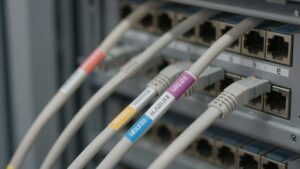
The most effective implementations use color at multiple levels simultaneously: the cable jacket, the patch panel port label background, the patch cord, and sometimes the port icon in the management software. This layered approach means a technician working in a busy patch panel can identify the function of a connection through redundant visual cues even if one indicator is obscured.
Document your color coding scheme explicitly in the administration system and include it in every cable plant as-built package. Post a color code legend card inside every telecommunications room door. When your organization adopts a color coding convention, treat it with the same rigor as a network addressing scheme. Deviations made by individual technicians, even well-intentioned ones, create inconsistencies that erode the value of the entire system over time.
Implementing TIA-606 Across Different Environments
The core requirements of ANSI/TIA-606 apply universally, but the practical implementation differs significantly across environment types. IT managers overseeing diverse portfolio deployments need to understand how to adapt the standard’s requirements to each context without compromising consistency.
Enterprise Office Environments
In a typical enterprise office deployment, the primary challenge is scale combined with constant change. Large office environments routinely process hundreds of moves, adds, and changes per year, each of which creates an opportunity for documentation to fall out of sync with physical reality. The key operational requirement in this context is a MAC workflow that makes updating the administrative record as frictionless as possible for the technician performing the work.
This means integrating the cabling administration system with the IT ticketing system so that every MAC ticket automatically generates a documentation update task. It means providing technicians with mobile access to the cable plant database so they can update records in the field rather than relying on paperwork that may or may not make it back to a central administrator. And it means regular physical audits, at minimum annually, where a random sample of cable records is verified against the physical installation to catch drift before it becomes systemic.
For enterprise office environments, Class 2 administration is typically the minimum appropriate level. Organizations managing their broader communications infrastructure, including unified communications platforms and contact center systems, will find that the same discipline applied to cable administration extends naturally to managing the broader technology stack. If you are evaluating unified communications platforms alongside a structured cabling refresh, the guidance in resources like The Essential Guide to Choosing Your Next Unified Communication and Collaboration Platform provides useful context for aligning physical and logical infrastructure planning.
Data Centers and Colocation Environments
Data centers represent the most demanding implementation context for TIA-606 because the consequences of administrative errors are most severe, and the density of infrastructure components is highest. A single 42U equipment rack can contain hundreds of individual cable termination points, all of which must be uniquely identified and documented in a system that supports rapid troubleshooting and change management.
The data center environment also introduces specific challenges not present in office environments: hot and cold aisle thermal management affects label material selection, high cable density in cable trays makes visual access to individual labels difficult, and the operational tempo of a production data center often pressures technicians to skip documentation steps during urgent changes. Intelligent patching systems address this last challenge by automatically detecting physical layer changes and flagging undocumented connections in the management system.
Data center implementations should incorporate the following TIA-606 specific practices: top-of-rack labeling for every vertical cable management section, row and rack identifiers encoded in every component’s unique ID, separate color coding conventions for in-row versus end-of-row switching connections, and structured documentation of power and ground connections in addition to data cabling. The interaction between data center infrastructure management and broader enterprise UCaaS and CCaaS platforms is a growing consideration for IT procurement leads, and resources like Unveiling the Top CCaaS Providers: Your Guide to 2025’s Best Solutions address how physical infrastructure decisions affect cloud service delivery.
Healthcare Facilities
Healthcare environments introduce regulatory complexity beyond TIA-606 itself. The Joint Commission, Centers for Medicare and Medicaid Services (CMS), and the National Fire Protection Association (NFPA) all impose requirements on healthcare telecommunications infrastructure that interact with TIA-606 compliance. Specifically, NFPA 99 governs the installation of communications systems in patient care areas and requires that all cabling be identifiable and traceable, a requirement that aligns with TIA-606 but adds healthcare-specific context.
In healthcare settings, redundant labeling of life-safety system connections, including nurse call, code blue, and emergency communications cabling, is not optional. These systems require positive identification at every termination point and pathway, and documentation must be available for inspection on demand. Healthcare IT managers should ensure that their TIA-606 implementation explicitly addresses life-safety infrastructure as a separately identified and color-coded category within the administration system.
Educational Campuses
Educational campuses typically involve Class 3 or Class 4 administration due to the multi-building structure and the presence of outside plant infrastructure connecting buildings. The particular challenge in educational environments is that cabling systems are often installed and modified over decades, with multiple generations of contractors and administrators contributing to the plant. This produces layered inconsistencies that require systematic remediation before a current TIA-606-C compliant system can be established.
Campus outside plant documentation under TIA-606 must include conduit routing, hand-hole and manhole locations, duct assignments within conduit bundles, and the identity of every cable occupying each duct. This information is essential not only for network management but for construction planning, since excavation near undocumented conduit runs creates significant risk of service disruption and infrastructure damage. GIS-integrated telecommunications management platforms are strongly recommended for campuses with substantial outside plant infrastructure.
Documentation Systems: Software Tools and Record Keeping Requirements
The administrative records required by TIA-606 are not optional supporting documents. They are a defined component of the infrastructure itself. A physical cabling plant without compliant documentation is, by definition, a non-compliant installation regardless of how perfectly the physical cables are terminated and labeled. Understanding what the standard requires for record content and how to select tools that support those requirements is essential for any IT procurement lead overseeing a cabling project.
Minimum Required Record Content Under TIA-606-C
For each termination hardware element (patch panels, wall plates, consolidation points), records must capture the unique identifier, physical location (encoded with the appropriate class hierarchy), the identifiers of all cables terminated at that hardware, test results or performance certification references, and the date of installation. For cables, records must capture the unique identifier, the identifier of the termination hardware at each end, the cable category or fiber type and count, the pathway identifier for the cable’s primary route, and the installation date.
For pathways, records must capture the unique identifier, the physical routing (origin and destination spaces), the pathway type (conduit, cable tray, J-hook, innerduct), capacity specifications, and fill percentage where applicable. Maintaining pathway fill records is particularly important for capacity planning. A pathway that is already at 60 percent fill may not accommodate the cable volume of a planned expansion without remediation work.
Software Platforms for TIA-606 Administration
The market for telecommunications infrastructure management software has matured significantly. Purpose-built platforms now offer features that were unavailable or prohibitively expensive when earlier TIA-606 revisions were written. Key platforms in this space include:
- CommScope imVision: An intelligent physical layer management system that combines auto-sensing patch panels with software to detect and record physical layer changes in real time. Particularly effective for high-change-rate data center environments. Pricing is enterprise-level, typically requiring direct quotes from CommScope or authorized partners.
- Panduit PanView iQ: A similar intelligent patching ecosystem from Panduit, compatible with the PanView iQ software platform for physical layer visualization and change management.
- Sunbird DCIM: A full-featured data center infrastructure management platform with strong physical layer documentation capabilities, power management, and environmental monitoring. Available in tiered pricing starting around $10,000 per year for mid-size deployments.
- Device42: A hybrid IT asset management and network documentation platform that handles cable plant records alongside server, VM, and application dependency mapping. Pricing starts around $1,500 per year for small deployments and scales with asset count.
- Netdisco / NetBox (open source): NetBox in particular has become a widely adopted open-source option for cable plant documentation, offering rack diagrams, cable patching records, and port assignment tracking. The open-source version is free to deploy, with commercial support available from NetBox Labs starting around $15,000 per year for enterprise support tiers.
For organizations also managing unified communications infrastructure alongside physical cable plant records, the convergence of physical and logical infrastructure documentation in a single platform is an emerging best practice. Understanding how physical layer administration connects to the broader communications stack is covered in depth in Mastering Unified Communication Collaboration: Your Guide to Seamless Teamwork and provides useful context for IT managers designing integrated infrastructure management approaches.
Common Implementation Mistakes and How to Avoid Them
After 15 years of evaluating enterprise network deployments, the same categories of TIA-606 implementation failure appear repeatedly. Knowing where projects typically break down is the most efficient path to avoiding those failures in your own deployment.
The most common mistake is treating labeling as an afterthought. Cabling contractors who are not explicitly required by contract to deliver TIA-606-C compliant documentation will frequently complete the physical installation and then backfill labels and records as quickly as possible to close out the project. Labels applied in haste are often inconsistent, placed incorrectly, or generated from naming conventions that were invented on the fly rather than specified in advance. The remedy is simple: require a naming convention document as a project deliverable due before physical installation begins, and tie final payment to documentation acceptance.
The second most common failure is documentation drift. Even installations that start with perfect compliance degrade over time when MAC workflows do not include mandatory documentation update steps. Within 18 to 24 months of an initially compliant installation, organizations without enforced MAC documentation procedures typically find 20 to 40 percent of their records inaccurate. Embedding documentation updates into the change management process and conducting annual physical audits are the two most effective controls against drift.
Third is misapplication of the administration class. Organizations that try to implement Class 1 administration in a clearly Class 3 environment produce identifier schemes that cannot uniquely identify components across multiple buildings without adding ad hoc prefixes. This creates exactly the kind of inconsistency the standard was designed to prevent. Always determine the appropriate administration class during the design phase, before naming conventions are developed.
Fourth is inadequate label material specification. Using office-grade labels in a data center hot aisle, or standard vinyl labels on outdoor above-ground equipment, produces labels that fail within months. The remediation cost of relabeling an entire installation, including the operational disruption required to access every component, far exceeds the marginal cost of specifying appropriate materials from the start. For organizations coordinating cabling infrastructure with enterprise communications platforms, the operational discipline required here parallels the administrative rigor covered in A Comprehensive Guide to Cisco Unified CM Administration: Best Practices and Key Features.
Integrating TIA-606 with Other Telecommunications Standards
ANSI/TIA-606 does not operate in isolation. It is one component of an interconnected family of standards that collectively define compliant telecommunications infrastructure. IT managers and procurement leads need to understand how TIA-606 interacts with the other standards they are most likely to encounter in RFPs, contractor proposals, and system acceptance testing.
ANSI/TIA-568.2-D governs the performance specifications for balanced twisted-pair cabling systems, including Category 6, Category 6A, and Category 8 copper cabling. TIA-606 administration records must reference the cable category for every horizontal and backbone cable. When a cabling contractor certifies a Category 6A installation, the test results must be linked to the cable’s TIA-606 identifier in the administrative system, creating an auditable chain from physical performance to documentation.
ANSI/TIA-568.3-D addresses optical fiber cabling performance, including the specifications for OM1 through OM5 multimode fiber and OS1/OS2 single-mode fiber. Again, TIA-606 administrative records must capture the fiber type and count for every fiber cable in the installation, enabling rapid identification of appropriate fiber when planning upgrades to higher-speed optical interfaces.
ANSI/TIA-569-D covers telecommunications pathways and spaces, defining the physical infrastructure that houses and routes cabling. TIA-606 pathway records must correspond to the spaces and pathways designed and built to TIA-569 specifications. When a building is designed to TIA-569 standards, the room identifiers, conduit routes, and equipment room layouts should flow directly into the TIA-606 naming convention as the basis for location hierarchy identifiers.
The Bottom Line
ANSI/J-STD-607-B addresses bonding and grounding for telecommunications infrastructure. TIA-606 includes explicit administration requirements for bonding and grounding conductors, which must receive unique identifiers and be documented just like data cabling. This is frequently overlooked in implementations that focus exclusively on data cabling, but grounding infrastructure documentation is a formal TIA-606 requirement, not an optional practice.
For organizations deploying enterprise UCaaS or CCaaS platforms on top of their structured cabling infrastructure, the physical layer compliance established through TIA-606 directly supports the reliability SLAs these platforms require. Understanding the full stack from physical cabling through to cloud communications services is addressed in resources like Unlock Seamless Collaboration: Your Definitive Guide to Enterprise UCaaS, and the connection between physical infrastructure quality and UCaaS performance is more direct than many IT managers initially assume.
Building and Evaluating a TIA-606 Compliance Program
For IT managers tasked with bringing an existing installation into compliance, or for procurement leads specifying a new installation, having a structured compliance program rather than a one-time project is the appropriate approach. Cable plant administration is ongoing operational work, not a check-the-box activity.
A functional TIA-606 compliance program includes the following elements. First, a current state assessment that inventories existing labels, records, and naming conventions and identifies the gap between current state and the appropriate administration class for the environment. Second, a remediation plan with specific deliverables, timelines, and cost estimates for bringing the installation into compliance. Third, a naming convention and documentation standard document that all current and future contractors must use. Fourth, integrated MAC workflows that make documentation updates a mandatory and auditable step in every change process. Fifth, an annual audit program that physically verifies a random sample of cable records against the installed plant. Sixth, a training program for all